How much does technology change in 16 years, 10 even?
What if 24 was made in 1994?
I do not fondly remember pagers or dial up modems.
Saturday, July 31, 2010
Thursday, July 29, 2010
Dining and Canal Boats
Menu ideas, adventure, luxury travel, Food Man Chan has it all
Yummy pictures of food on canal boats
referencis the Ladyline Hotel Boats
Yummy pictures of food on canal boats
referencis the Ladyline Hotel Boats


Tuesday, July 27, 2010
Was Apollo the Beginning, a Dead-End, or …?
"...Patterns in long-term trends over the last 200 years...point specifically toward the human colonization of space in the next 20!"
Is our space program at a dead end or are we headed back into space?
NASA's Kepler spacecraft hunting for Earth-like planets around other stars
has found 706 candidates for potential alien worlds while gazing at more than 156,000 stars
Since transits of planets in the habitable zone of solar-like stars occur about once a year and require three transits for verification, it is expected to take at least three years to locate and verify an Earth-size planet. The expectation is that Kepler should be able to identify at least 60 habitable earthlike planets in its 500 light year range.
Monday, July 26, 2010
Sunday, July 25, 2010
Friday, July 23, 2010
Low Solar levels may cause droughts
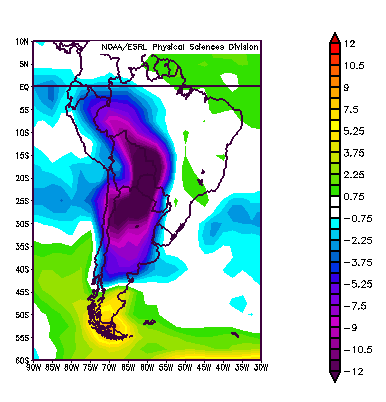
Strong correlations between water levels and solar activity.
There is some reluctance by some in climate research to attribute any major factor in our climate on the Sun. The Sun effects our weather, so why not investigate correlations over time? What climate models predicted cooling while CO2 still rises?
Given the unusually low solar activity, a long minimum and lower activity at the start of the latest solar maximum cycle, this next delayed solar maximum may mean we will see some historic droughts.
There is some reluctance by some in climate research to attribute any major factor in our climate on the Sun. The Sun effects our weather, so why not investigate correlations over time? What climate models predicted cooling while CO2 still rises?
Given the unusually low solar activity, a long minimum and lower activity at the start of the latest solar maximum cycle, this next delayed solar maximum may mean we will see some historic droughts.
Given the link between East African and central South American rainfall and solar activity, the list of economic impacts from the current solar minimum (Solar Cycles 24 and 25) can be expanded to:
1. Canadian agricultural will get a severe whacking from a shortened growing season and un-seasonal frosts.
2. 24 year drought in central South America
3. 24 year drought in East Africa
4. Paraguay and Brazil having severe power shortages.
This list is by no means exhaustive. The last time the world witnessed mass starvation was the 1965-67 drought in India which killed 1.5 million people. Things don’t look pretty.
Thursday, July 22, 2010
Water on the Moon is Widespread,
Lunar colonies would be more economical is water and air was available locally.
Certainly lot's of light on the moon, at least two week long days,
UT Researchers Discover Water on the Moon is Widespread, Similar to Earth’s
Certainly lot's of light on the moon, at least two week long days,
UT Researchers Discover Water on the Moon is Widespread, Similar to Earth’s
“Now we have ready sources of water that can be consumed by plants and humans but also electrolyzed into liquid hydrogen and liquid oxygen to develop rocket fuel,” Taylor said. “Until the recent discovery of water in and on the moon, it was going to be a very energy-intensive endeavor to separate these elements from the lunar rocks and soil.”
Sunday, July 18, 2010
A two-wheeled pickup truck
ZEV's dual purpose electric scooter
Sounds cool
Sounds cool
The Trail was originally intended to be a delivery and police-usage vehicle, but park rangers soon took a liking to it because it didn’t have a hot tail pipe that could cause forest fires. Hunters also reportedly like the fact that its quiet motor makes it stealthy, and allows them to access land that is closed to traditional combustion-engined vehicles. The first bikes sold went to residents of the Rocky Mountains, who appreciated how it didn’t lose power at higher elevations, unlike gas-powered vehicles. ZEV also suggests it could be used as a runabout for yacht and RV owners who don’t want to deal with transporting flammable gasoline.
There are two models of the Trail, the 5100 and the 6100. So, what makes the bike rough n’ tough, apart from an optional camo paint job? For one thing, there’s a big-ass lithium battery - 4.32 Kw on the 5100, and 5.04 on the 6100. These batteries give the bike the maximum range of any electric scooter according to ZEV. The 5100 can travel up to 70 miles (113 km) on one charge, while the 6100 manages 85 miles (137 km)
Saturday, July 17, 2010
More on $100 mini fuel cell, energy and cost savings
This makes a lot of sense and the fact that there is a method with the HydroPak
and electricity and water to recharge the canisters the MiniPak uses makes this a viable solution. Traveling and buying or trading in used canisters for recharged ones, even in remote locations seems like a useful market system and could be done on or off the grid.
Efficiency
About 50% of energy used in the world is lost to transmitting over wires. And AC to DC recharger works at 50% efficiency so to recharge from AC means a 25% energy efficiency.
Cost
The Horizon MiniPak replaces 1000 AA Alkaline batteries, which would cost $1500 to $2000 with a $100 unit.
Refills
From the Horizon Web site order page
Source of quotes www.gizmag.com
and electricity and water to recharge the canisters the MiniPak uses makes this a viable solution. Traveling and buying or trading in used canisters for recharged ones, even in remote locations seems like a useful market system and could be done on or off the grid.
Efficiency
About 50% of energy used in the world is lost to transmitting over wires. And AC to DC recharger works at 50% efficiency so to recharge from AC means a 25% energy efficiency.
Cost
The Horizon MiniPak replaces 1000 AA Alkaline batteries, which would cost $1500 to $2000 with a $100 unit.
Refills
From the Horizon Web site order page
The MiniPAK portable electronic device charger is a palm-size universal portable power charger and power extender for ANY electronic device requiring up to 2W of power. Devices compatible with the MiniPak include cellphones, but also smartphones, gaming devices, GPS handhelds, small lighting devices and MP3 players. The MiniPAK device integrates a passive air-breathing fuel cell and a "solid-state" hydrogen storage unit. The MiniPak DC power output is 2W (5V, 400mA), delivered through standard micro-USB port and a multi-choice cable. The device is supplied with 2 refillable and ready to use solid state hydrogen cartridge.While a cartridge replacement and filling infrastructure develops, Horizon took the extra step to develop a home refueling system called "HydroFILL" - sold as a separate accessory for added convenience. The MiniPAK is positioned to address gaps in providing energy "on the go" to power-hungry device users, as well as a low cost energy storage option for emergency and long duration off-grid power users.
Similar to a pocket-size distributed energy system, it avoids the energy losses that occur between the power plant and the battery operated devices that we charge from powerpoints. Cumulatively, these losses are massive. There are roughly 10,000 power plants in the US with an average thermal efficiency of 33%, and transmission losses of around 5-10%. When it comes to portable electronics, the US Environmental Protection Agency estimated that in 2004 in the US alone, there were 2.5 billion AC to DC power adapters consuming 207 billion kWh per year or up to 6% of the US$247 billion national electric bill. It is further estimated that 6 to 10 billion similar devices are presently in use worldwide, operating at an energy efficiency of around 50%. Whereas the MiniPak is not applicable to all AC to DC powered devices, it can indeed participate in reducing billions of dollars of wasted energy costs.
Besides contributing to overall efficiency, Horizon’s new micro-fuel cell system offers numerous environmental benefits. Just one of its Hydrostik fuel cartridges can deliver the same amount of power over its lifetime as over 1000 disposable alkaline AA batteries, while storing more energy at a lower cost. In addition, the cartridges do not contain any toxic materials and can be completely recycled, using conventional methods.
Source of quotes www.gizmag.com
Monday, July 12, 2010
Jay Leno 3D printing car parts
Custom printing of parts, telecommuting, maybe people will need less transportation in the future.
“Tonight Show” host Jay Leno has an industrial version in the Burbank garage that houses his collection of more than 200 vehicles. His mechanics design hard-to-find parts on a computer and then use the machine to make them real.
“It's a bit like when I was a kid and I watched ‘The Jetsons,' and they'd walk up to a machine and press a button and get a steak dinner with the baked potato sitting next to it,” Leno said. “But instead of a steak dinner, you're getting an old car part.”
WSJ: The Climategate Whitewash Continues
No significant changes in how the CRU functions for now, mostly to protect tens of millions in funding. I guess the CRU is too big to do wrong. Cooking data, trying to suppress other scientists papers, refusing to honor information requests all sound pretty wrong to me.
Last November there was a world-wide outcry when a trove of emails were released suggesting some of the world's leading climate scientists engaged in professional misconduct, data manipulation and jiggering of both the scientific literature and climatic data to paint what scientist Keith Briffa called "a nice, tidy story" of climate history. The scandal became known as Climategate.
Now a supposedly independent review of the evidence says, in effect, "nothing to see here."
It's impossible to find anything wrong if you really aren't looking
Thursday, July 8, 2010
496 scientists: A climate scientist enemies list?
Nice to see that almost 500 scientists are being tracked as enemies of climate research. Freeman Dyson is a great scientist and has many thoughts on climate and how to approach the problem as a scientist.
I would argue that this list is another example of how little science there is in the current climate belief system. Lot's of fear and intimidation being used when open data sets and cooperation is really how science works. Publish the prediction models and let others openly review your methods. That is how science is done.
Making lists and keeping peoples papers from being published and hiding data and threatening to destroy emails rather then met Freedom of Information requests are not scientific or signs that there is a valid theory here.
This does not help those that claim the science is settled or is being done properly.
and
I would argue that this list is another example of how little science there is in the current climate belief system. Lot's of fear and intimidation being used when open data sets and cooperation is really how science works. Publish the prediction models and let others openly review your methods. That is how science is done.
Making lists and keeping peoples papers from being published and hiding data and threatening to destroy emails rather then met Freedom of Information requests are not scientific or signs that there is a valid theory here.
This does not help those that claim the science is settled or is being done properly.
The National Academy of Sciences, in its official journal Proceedings of the National Academy of Sciences, has just published a list of scientists whom it claims should not be believed on the subject of global warming.
and
Notice that I am not saying that there has been no warming, just that the available raw data that I’ve personally been able to check do not show it. Until all the raw temperature data are placed online, so the data can be checked by anybody, a rational person has to suspend belief in global warming, to say nothing of AGW.
Subscribe to:
Posts (Atom)